

Work with the Sympose agent
Give Sympose useful direction, choose an appropriate model, and collaborate against the current project.
Sympose works against the real state of your project. It can inspect the arrangement, tracks, clips, devices, effects, automation, transport, assets, and export readiness before deciding what to change. It can also run a local measurement of levels and loudness on a clip, track, or the mix. That is a numeric analysis, not listening.
Give direction, not implementation instructions
Describe the musical outcome, the relevant scope, and anything that must remain unchanged:
- “Make the second chorus hit harder, but keep the vocal melody.”
- “Humanize the verse drums without moving the downbeats.”
- “Use a warmer bass sound and leave the notes alone.”
- “Explain why this transition loses energy before changing anything.”
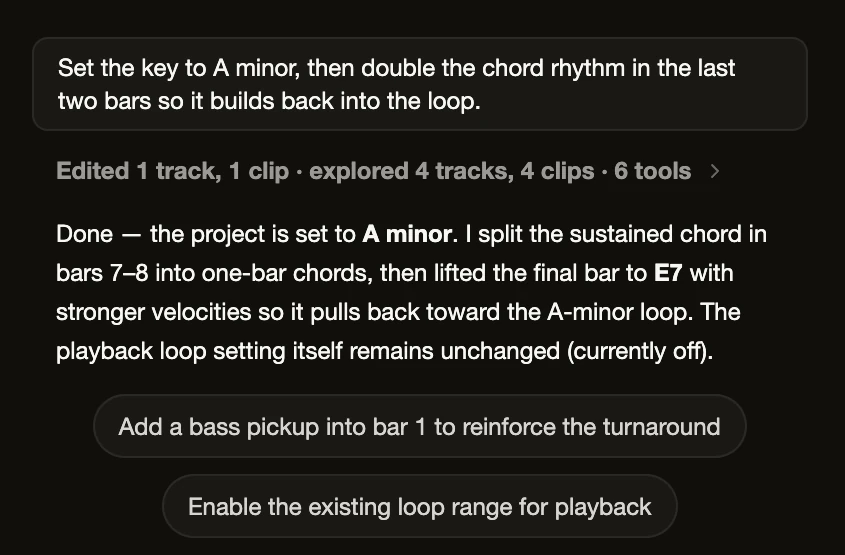
Names and selections help Sympose target the correct material. Select the relevant clip or use clear track and clip names when a request could be ambiguous.
Use the project as context
You can begin from language, performance, imported material, or direct edits. Sympose reads the latest project state, including changes you made after an earlier run. You do not need to paste note data or device settings into chat.
Scope the work
There are no separate agent modes: every conversation can discuss, explain, and edit. Say what you want in the request. Ask for an explanation or an approach first when you want to agree on direction before anything changes, and name the tracks or sections that are off limits.
For multi-step work, Sympose shows a Tasks list in the chat so you can follow what it is doing. Sympose may ask a focused question when taste or ambiguity would materially change the result. It should not interrupt you for information already visible in the project.
Choose how much effort
The model menu in the composer shows the current preset. Select it and move the slider to trade speed for depth: Quick is for fast answers and small edits, Balanced for everyday production work, and Deep for the hardest problems. The menu shows which model and effort level the preset uses and, in general terms, how many credits it uses per message. A preset your plan does not include shows a lock and says Available on Pro; select it to see your upgrade options. A model you picked yourself shows as Custom, and moving the slider returns to a preset.
When the model or effort changes between replies, the chat shows a note where it changed. The next reply starts a new prompt cache, which can cost more credits. Exact model availability and plan access change over time; the model menu and live account surfaces are authoritative. When presets are not available, the model menu lists models instead. To pick a model and reasoning effort yourself, select Show advanced in the model menu (or turn on Show advanced model options in Settings > Models); the composer then shows the model and effort, such as Opus 5.5 Medium, and Show simplified returns to presets.
Let Sympose listen to an attached audio file
When you attach an audio file to a message, every model gets a written summary of it: format, length, sample rate, and channels. Three models can also listen to the audio itself: Gemini 4 Carbon, Gemini 4 Neon, and Gemini 4 Hydrogen. All three need a Pro plan. While one of them is selected, audio attachments show a headphones icon, and hovering the attachment says “This model can listen to the audio”.
- Sympose hears the audio only during the run you attached it to, including a file you attach while steering that run. Later messages in the chat get the written summary only.
- Sympose listens to at most 10 minutes per run. That limit covers the message’s audio files in order, plus any audio you attach while steering the run. When a file is cut short, Sympose is told how much it heard. If the first message already uses all 10 minutes, audio attached mid-run isn’t heard, and Sympose works from its summary.
- If a file can’t be prepared for listening, the message still sends, and Sympose works from the summary.
- Listening is billed as ordinary model input, at the selected model’s usual rate.
- The audio is sent to the model for that run only and isn’t saved in the chat history.
Keep working while Sympose works
While a run is active you can type a follow-up. Press Enter to queue it for after the run, or press Cmd+Enter or Ctrl+Enter to steer the current run with it. Use the Stop button in the composer to cancel. See Runs, questions, and confirmations.
Iterate
After a run:
- Audition the result in context.
- Inspect the affected tracks, clips, or devices, or open the Changes tab for a before and after view of each track.
- Refine it directly or give a narrower follow-up.
- Undo the turn, or revert a single track, if the direction is wrong.
Sympose reports what it changed and any uncertainty it can establish. Playback does not mean the agent heard or liked the result. Sympose can report measured levels and loudness when it runs an analysis, and those numbers do not amount to a judgment of how the music sounds.
Next, see Runs, questions, and confirmations or learn how to review agent work.